ALL ARTICLES
Home Additions 7 min readJuly 9, 2026
Do I Need a Permit for a Home Addition in Chesterfield County, VA?
Planning a room addition in Chesterfield County? Here's exactly when you need a permit, what the county requires (including when an engineer or soil report is needed), how review works, and the real risks of skipping it — from a licensed Virginia contractor who pulls these permits every month.
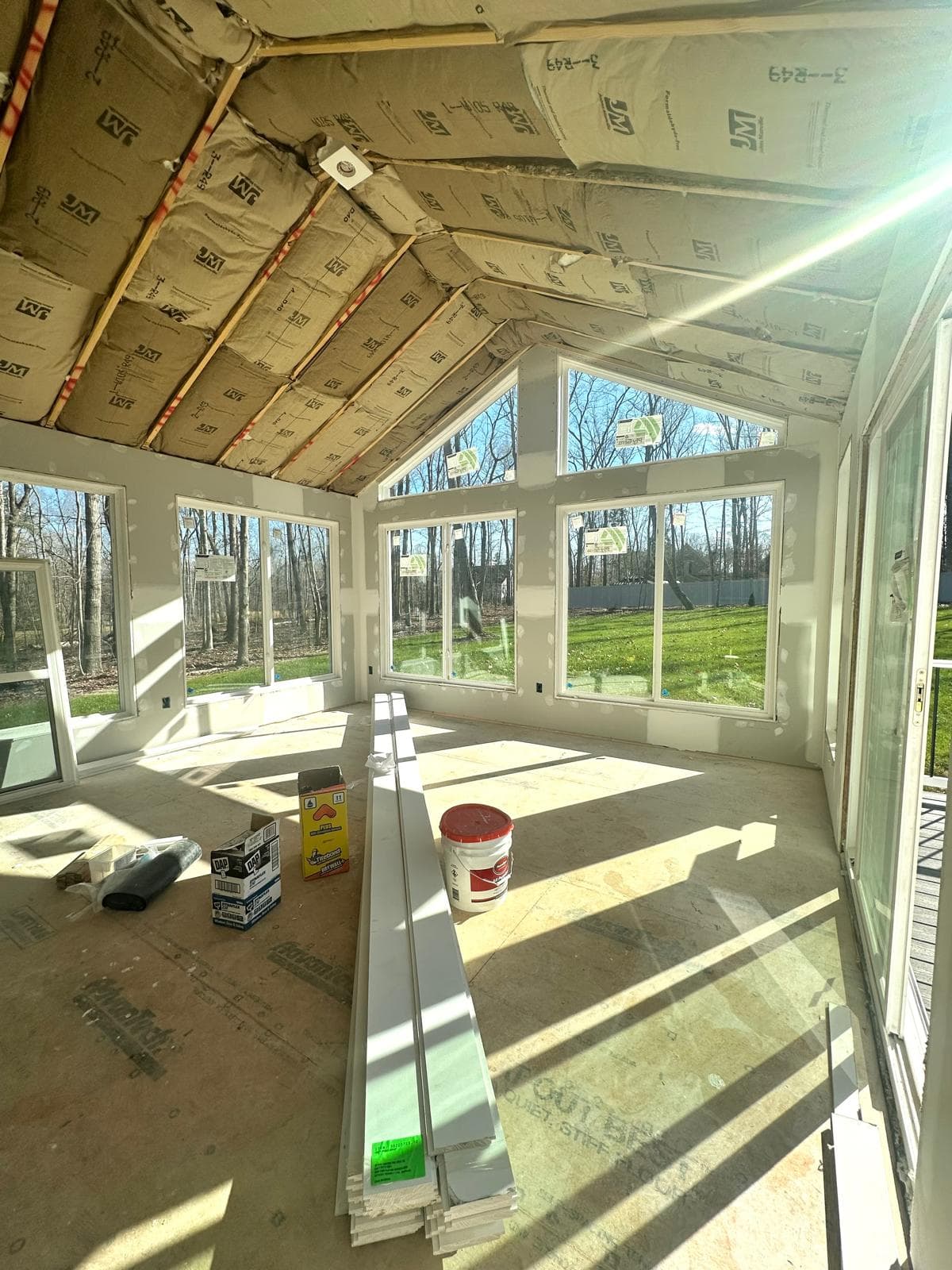
Short answer: Yes. Chesterfield County requires a building permit to build an addition onto an existing house or attached garage. It is also a more involved process than a deck permit: more drawings, a soil report in some areas, and more inspections. Here's what the county requires, what it costs, and why skipping the permit is one of the most expensive mistakes a homeowner can make.
When Is a Permit Required for a Home Addition in Chesterfield County?
Chesterfield's list of projects that require a building permit includes building an addition onto an existing house or attached garage, converting a garage to a habitable space, converting a deck or porch to a Florida room, finishing off an unfinished attic, basement, or room over a garage, and moving, adding, or removing a wall. Under the Virginia Uniform Statewide Building Code (USBC), that covers projects like:
- Room additions (bedrooms, family rooms, expanded kitchens) on an existing house or attached garage
- Second-story additions
- In-law suites built as part of the house
- Sunrooms and Florida rooms, including converting an existing deck or porch into one
- Garage conversions to living space, and finishing an attic, basement, or room over a garage
- Any change that moves, adds, or removes a wall, or alters your home's foundation, roofline, or structural framing
Do You Need an Architect or Engineer for a Home Addition?
Not always. Virginia law does not require an architect or engineer license for the person who prepares plans for single- and two-family homes of up to three stories (Code of Virginia § 54.1-402), and Chesterfield's own guidance says drawings may be prepared by the homeowner or contractor and that a registered architect or engineer is not required for most single-family dwellings. Some items do need an engineer, though. The county requires a sealed soil report showing shrink-swell potential for additions with habitable space in the Triassic basin, and an engineered footing where that potential is moderate or higher. Full-height two-story walls over 12 feet must be engineered by a registered design professional. MAS Contractors coordinates with licensed engineers and soil scientists when your project needs them, so you don't have to source them yourself.
| Item | What Chesterfield County asks for |
|---|---|
| Plot plan | Entire property with property-line dimensions and setbacks from the closest point of the addition |
| Construction drawings | Two or more copies: foundation and footing plan, floor plans, elevations, roof plan, framing, sections, and construction details |
| Soil report | Engineered soil report showing shrink-swell potential, required for additions with habitable space in the Triassic basin; an engineered footing is required where the potential is moderate or higher |
| Engineered items | Full-height two-story walls over 12 feet must be engineered by a registered design professional |
What Does the Home Addition Permit Process Look Like in Chesterfield?
- 1Prepare a plot plan showing the proposed addition and its distance from all property lines
- 2Prepare construction drawings (two or more copies): footing and foundation plan, floor plan, elevations, roof plan, framing, and building sections, plus a soil report when required
- 3Submit the application with the plans and pay the permit fees at the time of application
- 4Plan review — the county checks the submission, and other county departments, such as Planning and Environmental Engineering, are part of the approval
- 5Footing inspection — after the trench is dug and reinforcement is installed, before concrete is placed
- 6Foundation inspection — after backfilling the crawl space and before sill plates are placed
- 7Framing inspection — after all structural members are installed and the electrical, plumbing, and mechanical rough-ins are approved, before anything is concealed
- 8Insulation inspection — after framing is approved and before insulation is covered
- 9Final inspection — after all trade finals are approved, the addition is signed off and the permit closes
MAS Contractors manages every one of these steps. We submit the application, coordinate the engineer if one is needed, and schedule every inspection — you don't deal with Chesterfield's permit office directly.
How Long Does Chesterfield Permit Review Take for a Home Addition?
Chesterfield County's published goal is to review residential plans within 10 working days, according to its residential requirements pamphlet, but an addition involves more departments and more complex drawings than a deck, and the pamphlet is dated, so confirm current timing with Building Inspection at 804-751-4990. In our experience, plan on several weeks for review and build that time into your schedule. If a soil report is required, order it early, since it has to be submitted with your plans. We submit all documentation in week one of the project so this runs in parallel with material ordering, not on top of it.
How Much Do Home Addition Permits Actually Cost in Chesterfield County?
Unlike your construction budget, permit fees in Chesterfield County are flat fees, not a percentage of what you're spending on the addition itself. Here's the current fee schedule (effective July 1, 2026 through June 30, 2027) for a typical home addition:
| Permit / Inspection | Fee |
|---|---|
| Addition permit (base building permit) | $399 |
| Foundation Pour Inspection (new foundation) | $398 |
| Environmental Engineering site inspection (footprint change) | $50 |
| Electrical permit (rough-in required) | $114 |
| Plumbing permit (rough-in required, if applicable) | $114 |
| Mechanical/HVAC permit (new system or ductwork) | $114 |
| State levy | 2% of building permit fees |
Add it up and a typical single-story addition with a new foundation, electrical, and an HVAC extension runs about $1,050–$1,250+ in permit and inspection fees alone — separate from your actual construction cost. A Florida room or attached garage with occupiable space uses a slightly lower base fee ($392 instead of $399); a chimney or porch addition is just $171. These come from the Chesterfield County Department of Building Inspection residential fee schedule for 2026–2027. The county reviews and adjusts them annually, so always confirm the current schedule before finalizing your budget.
Pro tip: permit fees are collected at the time of application, before any work starts — budget for them as a project startup cost, not something you pay at the end. MAS Contractors includes all permit and inspection fees in your written estimate upfront, so there's no separate line item to surprise you mid-project.
Get a Free Home Addition Estimate
We handle the permits, coordinate any engineer or soil report your project needs, and schedule every inspection — you get a single point of contact from first sketch to final walkthrough.
What Happens If You Skip the Permit on a Home Addition?
This is where skipping the permit is far riskier on an addition than on a deck — you're not just risking a small structure, you're risking your entire home's legal square footage.
- Fees and penalties: when work starts without a required permit, Chesterfield charges a code investigation fee (the greater of 25% of the permit fee or $57) on top of the normal fees, and under Virginia Code § 36-106 violating the building code is a misdemeanor punishable by a fine of up to $2,500.
- Forced corrections: work isn't deemed in compliance until it is inspected and approved (Code of Virginia § 36-105), so unpermitted framing may have to be opened back up for inspection.
- Appraisal problems: an addition with no permit history can be flagged by buyers' inspectors and appraisers, and may not be counted the same as permitted finished square footage when you sell or refinance.
- Insurance: if a fire, structural failure, or injury happens in an unpermitted addition, your insurer may dispute the claim. Check your policy.
- Retroactive permits: many buyers ask for a retroactive permit, which can mean opening finished walls for inspection, at a much higher cost than doing it right the first time.
Pro tip: the building code requires the permit before the work starts (USBC § 108.1), so a retroactive permit means paying the extra investigation fee and possibly opening finished walls. Doing it right the first time is almost always cheaper.
Who Is Responsible for Pulling the Permit on a Home Addition?
Your general contractor should pull the permit — not you. Any contractor who suggests you pull the permit yourself as a homeowner to save money, or tells you an addition "doesn't really need" a permit, is asking you to take on liability that should be theirs. MAS Contractors pulls every permit, coordinates every inspection, and stands behind the work through final sign-off.
M
MAS Contractors LLC
Licensed Class A General Contractor · Richmond, VA · Serving Chesterfield, Henrico, Midlothian & surrounding areas since 2013.
More Articles
Ready for Your Free Estimate?
Serving Richmond, North Chesterfield, Midlothian, Glen Allen, and Henrico. Licensed, insured, and ready to start.